Plympton-Halifax-Kingston Express

  • Home
  • About Us
  • Subscribe
  • Rates
    • Advertisement Rates
    • Subscription Rates
    • Classified Order Form
  • Contact the Express
  • Archives
  • Our Advertisers
You are here: Home / Archives for News

ITW makes a federal case of it

December 13, 2018 By Abram Neal, Express Correspondent

Inside the John Joseph Moakley United States Courthouse. (Photo courtesy United States District Court for the District of Massachusetts.)

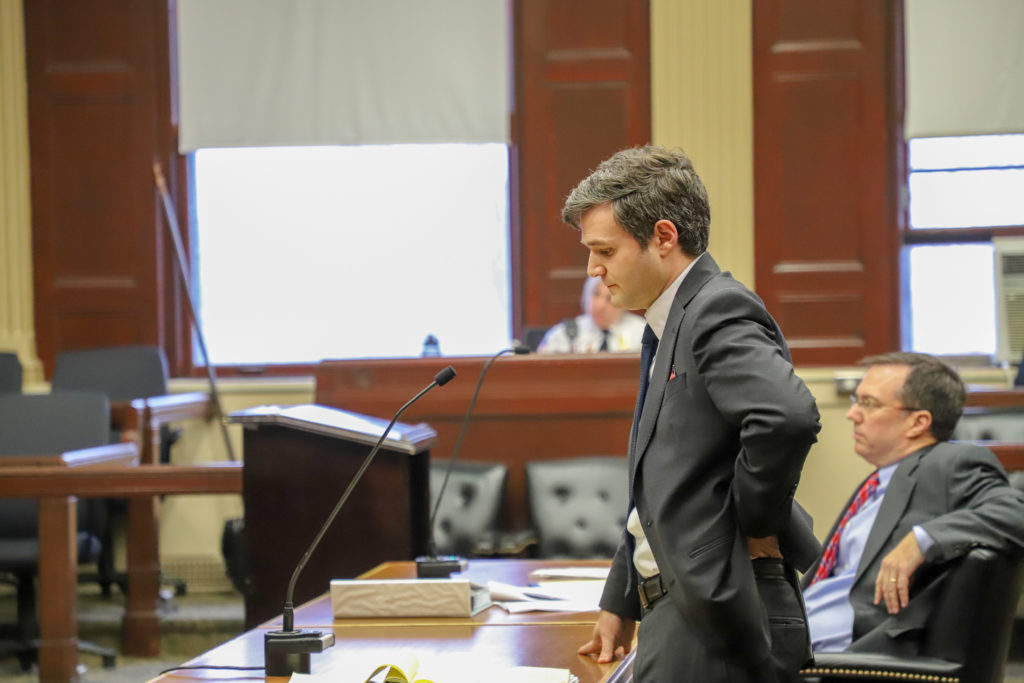
BOSTON —Attorneys Jeffrey Angley and Robert Hopkins, representing Industrial Tower and Wireless, LLC., of Marshfield, squared off against Plympton Town Counsel Robin Stein and her co-counsel, Jackie Cowin, representing the Town of Plympton Zoning Board of Appeals before US District Judge Denise J. Casper – possibly best known for presiding over the infamous James “Whitey” Bulger case – in courtroom 11 of the John Joseph Moakley United States Courthouse in the Seaport District of Boston Monday, Nov. 26.

ITW is suing the Plympton ZBA, alleging their right to build a 120-foot, lattice-style cellphone tower at 0 Palmer Road.

According to public records, the roughly four-acre lot was recently sold by Lawrence Marble, Jr. and Joy Marble, both of Halifax, trustees of ELBRAM Realty Trust, to Michael Umano, trustee of ITW Realty Trust, 40 Lone St., Marshfield, for $235,000. The sale was recorded with the Plymouth County Registry of Deeds Nov. 9.

The court proceedings were brief.

Casper held a commanding presence over the courtroom. Angley appeared at ease before the court and spoke more than the other three attorneys present. Stein was not as vocal as Angley. Neither of the co-counsels addressed the court directly.

The event, a scheduling conference, informed the court of the parties’ proposed schedule for discovery, disclosure and depositions. Casper worked amicably with the lawyers to finalize the schedule they had jointly submitted.

The lawsuit, filed in early September, will likely continue on through at least next summer, according to court documents.

Casper asked if there were any settlement prospects.

Angley replied that there were not. He said that most of these types of cases were disposed of by a judge with a summary judgement – an order ruling that no factual issues remain, and a complaint can be decided upon the facts by a judge without a trial.

ITW has a history of suing local government boards in federal court who have opposed them, according to court records. They have some history in Plympton, as well, as the ZBA decision denying them a permit to build their cellphone tower took several months to arrive at and they have had their eye on Plympton for “years,” according to testimony at the hearing in Plympton.

The communications company first came before the ZBA seeking zoning relief under the federal Telecommunications Act of 1996, which, according to Stein, was created to help build telecommunications infrastructure because most cell towers do not conform to local zoning bylaws in cities and towns across the nation.

According to Stein, the TCA of 1996 requires local zoning ordinances to be waived for a cellphone tower should a ZBA find that there is both a significant gap in cellphone coverage and that there are no alternate sites to locate it.

Stein warned the board that this type of case has been well litigated in the federal courts, in this circuit and others. However, there are examples where localities have prevailed against telecommunications companies in federal court on certain grounds, including aesthetics, such as the T-Mobile Northeast v. Town of Islip ruling of 2012 in the Eastern District of New York.

ITW made claims that 7,000 to 8,000 vehicles a day pass through an alleged 2.5 by 1.5-mile coverage gap. This was never independently verified, according to both ITW and town officials. ITW claims that it had been looking for “years” for a location to locate a cellphone tower and this one site was the only one of 36 they had exhaustively identified as suitable.

On Aug. 31, the ZBA voted down ITW’s application, 2-1, to build a tower on the business-zoned lot, surrounded by residential/agricultural zoned land, after multiple contentious hearings on the matter were held over the course of last summer.

Board members Dave Alberti and Harry Weikel voted against the tower, despite warnings by Stein that they were opening Plympton up to a federal lawsuit.

Board Chairman Ken Thompson voted for the project, with little visible enthusiasm, noting after that because the vote had to be unanimous, and he voted last, his vote didn’t matter.

During final deliberations, Weikel noted what he counted as 17 “significant” variances, not just the four in the application, that he believed the applicant required for the construction of a cell-tower. He listed other possible locations he found suitable, including town-owned parcels of land.

The lawsuit takes special note of Weikel’s objections, stating in a document filed Nov. 16 that, “[a]fter the close of the hearing and during the Board’s deliberations, one Board member then recounted a series of properties that ITW allegedly should have considered but as to which ITW was given no advance notice nor opportunity to respond. The exercise establishes the hostility of the Board to ITW’s application and the utter bad faith tactics of the Board.”

Weikel, at a hearing in August, stated as previously reported by the Express, “I’m here to protect the people … that’s the only reason I accepted this appointment.”

Filed Under: Featured Story, News

SL field hockey building up for the future

December 6, 2018 By Thomas Joyce

The Silver Lake High field hockey team had a bit of a rebuilding year this past season, but there were certainly positives to take away from it.

The Lakers finished the season at 2-14-2 under first-year head coach Lori Bennett, but saved some of their best play for the end of the season; in their final three games, they went 1-1-1, picking up three points in the standings. In both of the team’s wins, goaltender Sophie Russo had shutouts in net, making the job a lot less stressful for her team’s attack.

With the season over, the Lakers will lose eight seniors to graduation, six of whom were in their starting lineup. These players include Russo, Megan Fay, Hayden Wechter, Colleen Foley, Ashley Swift, Stephanie Bennett, Joe Detterman and Cassie Peck. Of that bunch, Russo, Fay and Foley were the team’s captains.

Although they are losing a pretty good sized senior class, they will have plenty of talent coming back next season. After all, field hockey teams have 11 starters which means nearly half of their starting lineup is expected to return.

Most notably, the team’s returning scorer, Abby Colton, should be back again next season. The junior put up a team-high six goals this past fall. This should prove especially beneficial for the team as offense was not their strong suit this year, so bringing back a top scorer along with some experienced varsity players may help them there.

In addition to Colton, junior Rosalie Moynihan, and sophomores Ava Mirisola and Paige Nally were among the team’s key players this past fall, so they should help propel the Lakers next season in even bigger roles.

The Lakers will also have some of their JV players from this past season help fill some of the voids on their roster next fall.

Filed Under: More News Left, News

Area 58 Community Access Media threatened by proposed FCC rules change

December 6, 2018 By Abram Neal, Express Correspondent

CARVER — The Federal Communications Commission is proposing new rules that would, among other changes, alter the way Area 58 Community Access Media— Plympton, Halifax and Carver’s local cable access provider— and other local cable access providers across the country are funded, according to Area 58 Executive Director Rich Goulart.

Currently, funds are set aside from cable franchising fees, or the fees that the cable companies pay for access to a particular community, for community television channel access, broadcasting equipment and other monies needed to run local cable television studios.

The channels are known as public, educational, and governmental or PEG channels. This is part of the Federal Cable Communications Policy Act of 1984, which requires cable companies to allocate a percentage of the profits they make from subscribers toward PEG channels.

Goulart said the proposed rules would allow cable companies to deduct from their franchising fees a value for these PEG channels, at a assessment they determine, as an “in-kind” donation.

He said this could lead to a situation where, if the rules were to go into effect— and he says they would go into effect immediately if they are enacted— the studio would be able to “keep the lights on,” but would not be able to pay its two full-time salaries, part-time salaries or purchase equipment to produce and disseminate television.

“This would have a crippling effect on public access,” he said. “This [proposal] came out of left field.”

The proposal has prompted the state’s two federal senators, Elizabeth Warren and Edward Markey, to send a letter to the chairman of the FCC, Ajit Pai, along with nine other senators opposing the rules:

“…[T]he proposal puts at risk critical funding for … [PEG] stations as well as broadband connections to schools and other public buildings. Our constituents watch PEG channels to monitor local government proceedings, hear the latest news from nearby college campuses, and consume other locally produced programming including emergency alerts and directives. Your proposal may jeopardize these important functions.”

PEG channels and their trade groups across the state and country have been united in their opposition to the proposed rule changes.

The rule was proposed by the FCC on Oct. 15. Although a comment period on the change has passed, comments to those already made are being accepted at fcc.gov/ regarding MB Docket No. 05-311.

Reply comments, letters of support or opposition and supporting documents have until 11:59 p.m. Dec. 14 to be submitted according to the instructions online.

“Massachusetts is one of the most vibrant states for public access,” said Goulart. “This is not good news…It’s a mess right now. It’s uncertain what it’s going to mean.”

Filed Under: More News Right, News

New Fire Chief, dog hearing, Highway Surveyor and Assessors at Plympton BOS

December 6, 2018 By Abram Neal, Express Correspondent

Plympton Animal Control Officer Griffin Webb came before the Board of Selectmen to testify at a dog hearing. Photo by Abram Neal.

PLYMPTON — The Plympton Board of Selectmen got off to an early start at 5:30 p.m. Monday, Nov. 19, when they welcomed new Fire Chief Stephen Silva, of Plympton, as head of the force. Area fire chiefs, family members, and Plympton Fire Department members were on hand to congratulate him.

The board next moved into a dog hearing, their first in many months, involving a dog named Mandy, a female brindle Plott hound, owned by Daniel Gazzola, who according to Animal Control Officer Griffin Webb, attacked another dog owned by Robert and Carol Quindley. Gazzola and Quindleys are neighbors on County Road.

Webb read his report into the record. “Quindley … stated that both of his dogs were outside in a completely enclosed fence attached to the house. He said that his neighbors dog ‘Mandy’ then got into an altercation with Mr. Quindley’s dog ‘[P]earl’ … resulting in a bite wound …”

Robert Quindley also testified before the board regarding the incident, stating that the attack went on for 15 minutes after Mandy jumped his fence, and that he was struggling to protect his dog, Pearl, with a stick the entire time.

Eventually, according to the report, Gazzola, the owner of the aggressor dog, removed her from the scene and was not present when Webb arrived.

Quindley rushed his dog to a veterinarian for treatment, he said.

Webb, at the suggestion of Selectmen at their last meeting, put Mandy under quarantine because she was not up to date on her rabies vaccine– or town license– and further placed the dog under a 14-day muzzle order before the hearing took place.

Webb described Gazzola as cooperative throughout the process, although he did not attend the hearing, which he was not required to do. Webb also said that Mandy was not aggressive to him, but that there was not another dog around at the time to “test” her behavior around other dogs.

Selectmen largely took Webb’s recommendation and ordered that Mandy be under the direct supervision of her owner at all times while outside her home, including on their property.

If she isn’t on a leash or a proper run, then she must be muzzled, according to the board’s order.

“Muzzles are tough,” said Webb. “I don’t want to see the dog muzzled outside for the rest of its life.”

But the board felt the need to protect the town, they said, and the dog can be unmuzzled if it is on a leash or run.

“I’m not up for another encounter,” said Quindley. His wife, Carol, agreed. “I just hope this works,” she said.

“So do we,” said Joy.

Later, Scott Ripley, Highway Surveyor, came before the board regarding speed limits, this time stating that it was unlikely the town would be able to set a blanket speed limit across the whole town, unless otherwise posted, as towns that choose this method of enforcement must be determined by the state to be high density.

Citing “town’s rights,” Selectman Mark Russo asked for permission from his colleagues to spend about a half-hour with Town Counsel to explore the issue further, and they agreed.

As the Express has previously reported, the state is changing some speed limits in Plympton and are replacing signs for free as part of a regional grant program with the new speed limits.

The Massachusetts Department of Transportation (MassDOT) sets these speed limits, not municipalities, according to their own rules and regulations.

This has upset some residents who have said they feel the speed limits are too high.

Finally, the Board of Assessors came before selectmen to hold the annual tax classification hearing. It was not attended by any residents.

At the recommendation of the Assessors, Selectmen adopted a singular rate across all classes of property for fiscal year 2019: “residential, commercial, industrial and personal property at their full and fair cash value of the tax levy, resulting in a single tax rate.”

The actual rate will be set after it is certified by the state, according to Wendy Jones, assistant assessor.

Filed Under: Breaking News, News

HES School Committee gets lesson on equity from SLRSD SPED director

December 6, 2018 By Abram Neal, Express Correspondent

From left, SLRSD Superintendent Joy Blackwood, HES School Committee Chair Summer Schmaling, members Alex Meade, Gordon Andrews, Allison Vance and Robert Johnson. Photo by Abram Neal.

HALIFAX — Marie Grable, Director of Special Education for the Silver Lake Regional School District, made a presentation about the state of her department and how it affects the Town of Halifax to the Halifax Elementary School Committee on Monday, Dec. 3. Throughout, she put an emphasis on equal access and equity as a means to achieve equality for all students, something she said she wanted to highlight.

But by the end, Grable said she was at the “mercy” of the board. In apparent reaction to interruptions and vocal frustration from three of the five school committee members during her presentation, notably from chair Summer Schmaling, and members Alex Meade and Gordon Andrews, she said she would be happy to provide statistics presented a different way or change the direction of the program if the board wanted her to.

Very early on, during the first slide with significant information, the interruptions and questions began. School committee members appeared to be trying to get a better handle on how to predict the numbers being presented to them.

“We’re here for 100 percent of the students but 20 percent of the students are affecting the budget this much, and there’s nothing we can do about it, frankly,” said Meade.

Grable noted that special education is required by law, and is a “means of specially designed instruction, at no cost to the parents, to meet the unique needs of a child with a disability.” The SLRSD is also responsible for transportation costs for students receiving services outside of Halifax, she said.

This access to education for some students is met in-house, for other students requires placement in programs at other schools in the district or programs out-of-district, including collaboratives and alternative schools. Tuition for these programs can be quite costly, according to Grable’s presentation.

Special education budgets are notoriously difficult to anticipate because special education is mandatory, can be costly, and the cost is subject to the needs of the students currently in the district.

She discussed certain disability types that Massachusetts regulations require educators provide modifications for, including: autism, developmental delay, intellectual impairment, sensory impairment, neurological impairment, emotional impairment, communication impairment, physical impairment, health impairment and specific learning disability.

But Schmaling stated that she didn’t think that emotional impairment belonged on the list of disability classifications, and Meade agreed.

Both indicated they did not think that the public’s perception of disability included “emotional impairment.”

Emotional impairment includes, according to state and federal law, such disabilites as, “an inability to learn that cannot be explained by intellectual, sensory or health factors; an inability to build or maintain satisfactory interpersonal relationships with peers and teachers; inappropriate types of behavior or feelings under normal circumstances; a general pervasive mood of unhappiness or depression; or a tendency to develop physical symptoms or fears associated with personal or school problems.”

There are 128 students from Halifax, aged 3-22, receiving special education services this year, stated Grable, up from 118 in 2015. For those students receiving services at HES, that represents close to 20 percent of the school’s student population, according to some quick math done by the board (the state average is about 17 percent, said SLRSD Superintendent Joy Blackwood). But, out-of-district placements are down from 26 to 16 from 2016.

“We’re moving in the right direction,” said Grable. “My goal is to have the most students receiving their education in the least restrictive setting.”

The board wanted more historical data to help better budget for special education. But Grable said she didn’t think that would help much.

“It’s hard [to predict funding] because it’s such a moving target,” said Blackwood.

Schmaling and Blackwood pointed out that just one student moving into the district could cost $100,000 or one moving out could save the district $100,000 (hypothetically).

But in the end, the board appeared glad to hear Grable’s report, however they felt about it. “It’s super awesome that you came in,” said Schmaling.

Filed Under: Featured Story, News

New Fire Chief Silva sworn, says Dept. is ‘ready for the next level’

November 29, 2018 By Abram Neal, Express Correspondent

Town Clerk Tara Shaw swears in new Plympton Fire Chief Stephen G. Silva. Photo by Abram Neal.

PLYMPTON — Stephen G. Silva, of Popes Farm, took over as the Plympton fire chief Monday, Nov. 19. The following day, he was personally cleaning out a storage room at the fire station— where he envisions a bunk room to replace the trailer out front— and was already easily joking around with the men and women who make up the department.

“Firefighting is a calling,” he said. “I’ve been chasing firetrucks since I was riding a bicycle.”

The 23-year Plympton resident said he is proud to take over the department and has a wide range of experience, including more than 40-years in firefighting and emergency medical services, in both the public and private sector. Most recently, he was a lieutenant with the Middleborough Fire Department, where he frequently served as shift commander.

But before Silva talked much about himself, he wanted to point out the dedication of the firefighters of the Plympton Fire Department.

The department went through a difficult period this year, he conceded— including an outside investigation, by Municipal Resources, Inc. The investigative report went so far as to describe “a department in crisis” when it was written in February. In March and May the department lost their chief and acting-chief, respectively.

Yet Silva said the department was not in crisis, it was a department “searching for an identity.”

The firefighters have been functioning quite well in the absence of a chief and in the hands of senior leadership, he pointed out, but now the department is ready for the “next level … and when we get there, we’ll go to the next level again,” he said. “We do have dedicated people.”

Silva is an EMT/paramedic, rescue specialist and special operations operator for the Massachusetts Department of Fire Services. In addition, he teaches rescue techniques and is an instructor at Massasoit Community College.

In the late 1970s and early 1980s, he worked as an EMT, first getting excited about working in the field while a student at Syracuse University in New York. He eventually returned to Massachusetts where he has held a series of jobs in urban, suburban and rural settings for both cities and towns and in the corporate sector.

He has done everything from running his own ambulance company in Brockton, Exodus Medical Transportation, to establishing the first fire-based Advanced Life Support (ALS) EMS system on the South Shore, to work as a flight paramedic.

At his interview before the selectmen, he came recommended by many area fire chiefs, including Whitman (who is the president of the Fire Chiefs Association of Massachusetts), Duxbury, the current and retired chief of Middleborough, the retired chief of Kingston and the deputy chief of Hanson, among other fire officials.

Silva spoke of some of the issues concerning him in town. One topic he came back to in several different ways was adapting: learning to extricate accident victims differently as cars change, to fight fires differently as development brings more houses to the edges of forests and the opioid epidemic— which he says is truly an epidemic.

Silva said that cars have changed over time, and that rescuers have had to adapt to changes in vehicles in order to rescue accident victims. He added that when he worked in Middleborough, he would respond to horrific crashes on I-495, and that cars are made very differently than they used to be. “It’s become more and more technical,” he said.

He also said that while Plympton is not California— referring to the wildfires occurring there now— the town needs to be careful how it chooses to develop. He said that brush fires can and do happen, and that there have never been so many houses close to the edge of forests. This has led to changes in the ways that fires are prevented and fought, he added.

Silva spoke also of the opioid crisis, which he labeled as endemic of something wrong with society, although he doesn’t know exactly what it is. Although he is not certain of the number of calls related to opioids in Plympton yet, he spoke passionately about the issue county and country-wide.

“It’s a sign of a deeper problem,” said Silva.

Despite the challenges, Silva is keeping his eye on the future. “We’re coming out of the background,” he said of the PFD.

“I’ve been overwhelmed by the ideas, the sense of community and energy here. Firefighters are cut from a different cloth … they’re different. Different in a good way,” Silva added.

Filed Under: More News Right, News

Health agent wants charges dismissed

November 29, 2018 By Abram Neal, Express Correspondent

PLYMOUTH — On Nov. 7, Plympton Health Inspector, Robert Tinkham, Jr. filed a 13-page motion to have five counts of a nine-complaint civil suit against him by the Carver, Marion, and Wareham Regional Refuse Disposal District dismissed. He is accused, along with two co-conspirators, Ray Pickles and his wife, Diane Bondi-Pickles, of defrauding the regional waste district of $838,458.22.

Tinkham, of Carver, previously worked as the Carver Health Agent, and, in that capacity, served as Carver’s representative to, and, at times, chairman of the committee overseeing the waste district, according to court records.

The lawsuit, which was originally filed in June and was amended against Tinkham— only— in August, accused him of conversion and civil theft, fraud, civil conspiracy, as well as violations of the Uniform Procurement Act and the conflict of interest law.

Tinkham, through his Brockton-based attorney John Fink of Sims & Sims, argued that the August amendment to the complaint was filed improperly, in a “bad-faith effort to needless[ly] complicates [sic] the litigation by presenting multiple active complaints,” in violation of the rules of civil procedure.

The waste district responded to this motion to dismiss Nov. 19.

It contains some of the strongest language yet used against him and responds point-by-point to his motion.

“Defendant Robert Tinkham, former chairman of the District’s governing committee and duly appointed representative of the Town of Carver, participated in this scheme by conspiring with the other defendants to install co-defendant Ray E. Pickles as the District’s executive director and then by presenting Pickles with numerous fake-claims over many years for payment under the guise of providing landfill inspection and other services. Notwithstanding these claims, Defendant Tinkham did not provide any services to the District and instead he abused his position of trust and confidence to defraud the District, a public entity, of more than $260,000,” the waste district says.

Tinkham argued that all of the defendants in the case, including Pickles, Bondi-Pickles and a corporation the two controlled, Moss Hollow Management Corp., are accused by the plaintiff with little distinction.

“All of the Claims refer only to the ‘Defendants’ collectively using the defined term ‘Defendants’ and contain absolutely no factual allegations that identify which particular Defendant is being accused of what allegedly improper behavior,” Tinkham’s motion states.

Therefore, says the filing, it cannot be determined which defendant is being accused of which alleged act and thus the complaints should be dismissed, as has been the case in similar litigation.

Similarly, he states that he is “entitled to know which statements were made by whom and at what time so that he may defend himself…” in relation to allegations he broke the law.

But the district claims that “In its Amended Complaint, the District sets forth specific and detailed factual allegations, in 47 numbered and lettered paragraphs, describing a scheme of fraud perpetrated by Defendant Tinkham, including when he committed the fraud, how he committed the fraud and the extent of the damage he caused. Specifically, the District alleges that Defendant Tinkham made numerous false representations of material fact, over the course of more than twenty years, by submitting false invoices requesting payment for services that he did not perform for the District.”

Tinkham points out three reasons that the claims he broke the Uniform Procurement Act should be dismissed: “failure to allege any contract subject to the laws,” that he was not a “procurement officer,” and that there is no right to privately sue under the act– enforcement is through the Office of the Inspector General or the Attorney General, he says. (The OIG is investigating, according to documents discovered in court files.)

“[T]he count must be dismissed because nowhere in the four corners of the complaint does the District allege it had a contract with Tinkham subject to the Uniform Procurement Act…” he argues.

Tinkham finally states that a party to the litigation was left out, also violating rules of civil procedure, the Southeastern Massachusetts Resource Recovery Facility (SEMASS) in Rochester. SEMASS contracts make up a large portion of the complaint, and they were paying the salaries and wages of workers according to the plaintiff, Tinkham says, and he argues they should have been subject to the litigation.

Because the complaint “seeks recovery of sums allegedly unlawfully paid by SEMASS…” he alleges that they weren’t included in the litigation because the waste district is fearful any recovery from the defendants may be returned in some part to SEMASS.

The plaintiffs say that SEMASS is not a necessary party as they do not purport to assert a claim against them.

Tinkham is an employee of the Town of Plympton, hired by the elected Board of Health at a meeting Jan. 9, 2018.

The case is ongoing and has been reassigned to Brockton from Plymouth. The next hearing on the matter is scheduled for Jan. 14, 2019 at 2 p.m. in Brockton Superior Court.

Tinkham denies all allegations.

Filed Under: More News Left, News

Selectmen give dog a pass

November 29, 2018 By Abram Neal, Express Correspondent

HALIFAX – Halifax selectmen welcomed their new police chief, Joao Chaves, on Tuesday, Nov. 27, at a more than hourlong celebration that brought together police from New Bedford where he formerly worked, along with area chiefs, members of the Halifax Police Department and the community-at-large.

Following that, the board went into their regular meeting, where they were in good spirits after two members had been on vacation. They held a dog hearing, met with Rich Goulart of Area 58 Community Access Media regarding live television broadcasts, and received an update on cemetery fees as well as the deteriorating Pine Street bridge from Highway Surveyor and Cemetery Superintendent Steve Hayward.

Dog Hearing

Margaret Compton-Severance of Cherry Street was before the board for a dog hearing stemming from an incident in October. It was one of the more acrimonious dog hearings in Halifax in recent times.

Compton-Severance was the owner of the “aggressor” dog, but Noreen Callahan, the Halifax Animal Control Officer, stated that Compton-Severance had done “everything right.”

But even being told that she had done everything right by the ACO did nothing to assuage her aggressive attitude.

The victim, a home health care aide who was assisting Compton-Severance’s mother, placed her hand through the puppy’s cage to either “console” or “say goodbye” to the dog– depending on who tells the story.

The dog bit the health aide, and she said it was a deep bite requiring a visit to the hospital, although there were no stitches required. “It was my fault,” she added.

Compton-Severance said she tried to assist the health aide. “I finally forced some Band-Aids on her.”

Compton-Severance said she didn’t believe the dog bit the health care aide. “Where are the medical records?” she asked. “Why aren’t they here?”

“She just said it was her fault,” pointed out Selectman Troy Garron, referring to the health aide and cutting off the cross-talking women.

“What action would you like to see this board take?” asked Garron of the health aide.

“What?” said the aide, misunderstanding several times before final exclaiming, “I don’t want any action taken.”

“We get involved any time there is a bite reported by a health agency,” Selectmen Chairman Kim Roy explained to the two.

Then, Compton-Severance started accusing the home-health aide of being involved in a Ponzi scheme.

This was too much for the board. “That’s beyond the scope of this hearing,” stated Selectman Tom Millias.

Roy entertained a motion to take no action on the matter, as Compton-Severance did not want “a bite on her dog’s record,” no injury occurred and the victim did not want the board to sanction the dog or its owner.

The board appeared relieved when the hearing was over.

“Live-live”

Area 58 Community Access Media director Rich Goulart came before the board to seek permission to make the necessary technical connections to go “live” with televised cable broadcasts of meetings in the Selectmen’s Meeting Room of Town Hall.

Plympton recently agreed, and Goulart said Carver has been broadcasting live for “years.”

From a technical standpoint, all of the equipment is in place for either live broadcasts or for the Area 58 studio in Carver to process the broadcasts with a direct link to Halifax, except for the town purchasing a static-IP address, something that is inexpensive and relatively simple, he noted.

Garron was skeptical. He asked whether the change was really necessary, but he seemed resigned when the move appeared inevitable.

Roy joked that she wanted her hair and makeup done if the board meetings were broadcast live. On a serious note, she was concerned if it would cost the town much money, and Goulart assured her the cost was minimal.

Millias didn’t express a strong opinion one way or the other. He differentiated between going “live”— meaning that the technical ability would be there for the room to connect up with the Carver studio— and going “live-live,” meaning that the board would have a policy on whether its meetings would actually be broadcast live.

In the end, Goulart got permission to take the room “live” as Millias had defined it. The room will have the technical ability to broadcast live and to communicate with Area 58’s studio directly, but the board has not come up with a policy for going “live-live,” in other words, for its meetings, yet.

Highway/Cemetery Update

Steve Hayward, highway surveyor and cemetery superintendent, came before the board to discuss cemetery fees, cemetery rules and regulations, and plans for the Pine Street bridge.

Cemetery fees have been adjusted upward, but are still in line with other communities, if not a little low, according to Hayward. “Are we charging enough?” asked Roy.

Hayward said that they are.

He also adjusted the rules and regulations for Halifax Central Cemetery, which the board adopted, most notably that he will approve all plantings at gravesites.

Hayward also spoke about repairs to the Pine Street bridge.

Apparently disturbing to the board and to Town Administrator Charlie Seelig was news that plans alone for repairs to the ailing bridge would cost in the realm of $200,000.

The Massachusetts Department of Transportation (MassDOT) stated that the bridge is at a “critical level” of deficiency as reported by the Express last week.

“I’d like to find something [plans] on the internet, even, but I don’t know if that’s legal,” Hayward said.

Seelig was vocally and visibly flabbergasted by talk of the cost.

Hayward says he will continue to look into the matter.

Next meeting:

• The board will hold its next regularly scheduled meeting, the sole meeting for December, on Tuesday, Dec. 11, at 7:30 p.m. in the Selectmen’s Meeting Room of Town Hall.

Filed Under: Featured Story, News

Vandals on a spree

November 29, 2018 By Abram Neal, Express Correspondent

HALIFAX — Vandalism was reported at the historic Blacksmith Shop and School House, 490 South St., run by the Halifax Historical Society, over the Veteran’s Day weekend.

According to a police report, both buildings were broken into and two fire extinguishers from the schoolhouse were discharged, coating the interior of both historical structures with a fine white powder.

The fire extinguishers were later found in nearby bushes and in the Blacksmith Shop by police, the report says, and were fingerprinted by the Plymouth County Sherriff’s Department Bureau of Criminal Investigation (BCI).

The damage, which is expected to be covered by the town’s insurance policy, is estimated to be in the realm of $20,000, according to John Campbell, of the Halifax Historical Society. The town has a deductible of $5,000, he said.

A hazardous materials team will need to be brought in to clean all of the surfaces in the buildings, and the items in them, including all of the historic blacksmithing tools.

Campbell said that the two buildings, normally only opened several times a year, would not be able to open in time for the upcoming annual Holidays in Halifax celebration Saturday, Dec. 8.

After the insurance company approves the claim, he said that it may take three to four weeks for the clean-up to be completed.

No items were reported stolen, although the police report notes that in addition to the fire extinguisher damage a door was found open and unsecured at the Blacksmith Shop and a window pane was broken at the School House.

The report also mentions that the burglar alarm systems installed in both of the damaged buildings were not in use at the time of the incident due to the number of false alarms caused by animals. The investigation is ongoing.

Filed Under: Breaking News, News

Savage shoplifting case continued without a finding

November 23, 2018 By Abram Neal, Express Correspondent

Edward and Christine Savage

Edward and Christine Savage in Hingham District Court on Wednesday, Nov. 14. Photo by Abram Neal.

HINGHAM— On Wednesday, Nov. 14, Edward and Christine Savage, of Plympton, came before Judge Heather Bradley in Hingham District Court for a hearing on a shoplifting case stemming from an incident at Kohl’s Department Store, 100 Derby St., Hingham in April 2017.

The Savages reached an agreement with Assistant District Attorney Frances Cannone, and Judge Bradley agreed to it, continuing the matter without a finding for six months with the condition that the Savages stay out of criminal trouble and stay away from Kohl’s at the Derby Street Shops.

The Savages were represented by Daniel Webster, a Pembroke-based attorney and former state representative.

A court official said the sentence is typical for a shoplifting case, but this case was hardly typical, as it was both lengthy for its type and at least one of the defendants is well-known to area residents.

Edward Savage was formerly the Hanson Police Chief who resigned in 2012 after an extensive outside investigation revealed he was reporting false and inflated crime statistics to the town for its annual town report for a period of seven to eight years, leaving an appearance that the department was struggling to keep up with the amount of work at its staffing levels at the time– among other substantiated allegations, according to the investigatory report by Alfred Donovan of APD Management, Inc. in 2012.

Several media outlets questioned whether the Savages received lighter treatment than other defendants because of Savage’s former position with the police, including WCVB-TV and The Boston Globe. A court official familiar with the matter strongly denied that the two received special treatment at any time.

According to the Hingham police report, “Edward took clothing off of the racks and tables and removed the hangers from them and then carefully folded them into the bottom of the carriage. He then brought the cloths [sic] to Christine who had an empty Kohl’s bag with her. She then brought the carriage with her into the woman’s [sic] dressing room. When she came out, she had the clothes tucked under the empty Kohl’s bag. The two of them then headed for the front door.”

They were apprehended by two Kohl’s loss prevention employees, who contacted police. The Savages were not cooperative according to the report.

The Savages were summonsed before now-retired Hingham District Court Clerk-Magistrate Joseph Ligotti, June 19, 2017, in a closed-door show of cause hearing, the audio of which was later released to media. Ligotti did not find probable cause to issue charges, which, said a court official at the time, is typical for minor cases where defendants do not have criminal records.

But Ligotti made it clear that he did not believe the two had made a mistake. “You want me to believe that two people have to go back to a car to get one wallet … I don’t believe either one of them,” he said in the recording.

He also questioned why the two were not arrested after being argumentative to Kohls employees and the Hingham police.

“I don’t know,” says the Hingham police prosecutor, Sgt. Steven Dearth.

Ligotti agreed to dismiss the charges, with the agreement of the police, if the Savages stayed out of legal trouble for eight months and wrote letters of apology to Kohl’s and to the Hingham Police Department.

In January, 2018, Ligotti retired and Andrew Quigley became the acting clerk-magistrate for Hingham District Court. Hingham police notified Quigley after the eight-month period that the Savages had never written a letter of apology to the police, so Quigley issued the charges, this time before a judge. An outside prosecutor, Frances Cannone, of Essex County, was brought in.

The Savages were arraigned April 2, 2018, on the criminal charges for not complying with the conditions of Ligotti’s dismissal. They later filed a motion to dismiss those charges Sept. 13, 2018.

At that hearing, the Savages’ attorney argued that the acting clerk magistrate, Quigley, should not have issued the criminal charges, and that he had “violated the integrity of the Magistrate’s hearing” by doing so, because the Savages thought they had until the very last day before the charges were dismissed to write their letters of apology. Webster said they wrote the letters. But it was only after criminal charges were being filed against them, according to Cannone.

During the hearing on the motion to dismiss, held before Judge John Stapleton, Webster read a quote from the original show of cause hearing:

“Okay, I am getting two letters written, signed by both people. I’m going to continue this matter until 2/28 of ’18 for dismissal. It will automatically dismiss on that date, no need to be back. Should you be dumb enough to do anything else illegal, this will automatically kick in and will automatically come back … and it will be issued,” Clerk-Magistrate Ligotti said.

Stapleton denied the motion to dismiss the charges noting that the court found that the acting clerk-magistrate, Quigley, had not violated the integrity of the clerk-magistrate hearing.

Finally, the Savages struck a deal with Cannone, this time with no requirement to write any letters, and Bradley approved the deal. Should the Savages follow its conditions by staying out of legal trouble and staying away from Kohl’s at Derby Street Shops, this may be the end of this legal matter for them. If they break those conditions, according to Bradley, they will be back before the court.

Filed Under: Breaking News, News

  • « Previous Page
  • 1
  • …
  • 147
  • 148
  • 149
  • 150
  • 151
  • …
  • 219
  • Next Page »

Your Hometown News!

The Plympton-Halifax Express covers the news you care about. Local events. Local business. Local schools. We honestly report about the stories that affect your life. That’s why we are your hometown newspaper!
FacebookEmailsubscribeCall

IN THE NEWS

The January Garden: Gardening Starts in Your Mind

February 6, 2026 By Stephani Teran

One of the first things people learn when they take an interest in gardening, is that it is … [Read More...]

FEATURED SERVICE DIRECTORY BUSINESS

Latest News

  • The Uncles
  • AG Campbell Sues Halifax Over MBTA Communities Non-Compliance
  • The January Garden: Gardening Starts in Your Mind
  • Stirring Up Something Special with Cookbook Club
  • A Storm is Born: What are the Miller Systems?
  • This Is Us
  • Plympton Approves New Accounting Software
  • Area residents named to dean’s list for the Fall 2025 semester at Quinnipiac University
  • Plympton Zoning Board Continues to Iron Out Plans for Ricketts Pond 40B Project
  • Silver Lake Debates Stabilization Fund

[footer_backtotop]

Plympton-Halifax Express  • 1000 Main Street, PO Box 60, Hanson, MA 02341 • 781-293-0420 • Published by Anderson Newspapers, Inc.